It is said that music is the universal language of the world. The simple sound of a single drum can elicit movement in anyone. But there’s a sound reason as to why music is so instrumental for early literacy in children. Phonological awareness, or the idea that words have specific sounds broken down into syllables, is an essential concept for children to acquire before learning to read. Music is a marvelous and effective tool for kids to become phonologically aware. Musical instruments, singing songs like “The Itsy Bitsy Spider”, and the simple task of clapping the syllables of your child’s name can help your little one grasp this skill rather quickly.
In children’s literature, phonological awareness can be developed through books with rhymes and words that focus on a specific sound. For example, in the book “Click, Clack, Moo”, the repetition of the line “Click, Clack, Moo” helps children focus on the letter “C” sound. Another way to increase phonological awareness is to find books where kids can acquire alphabetic knowledge, or the ability to become familiar with the alphabet. Chicka Chicka Boom Boom is a storytime favorite for us because it’s got a great rhythm and the tune is so catchy kids learn their ABCs in no time. Here are some other books and resources you can find at Yolo County Library that will increase your little one’s phonological awareness:
Pete the Cat and the Cool Cat Boogie
Pete asks his friends to teach him how to dance; the only problem is he keeps doing it all wrong! Owl’s wise words help Pete the Cat learn that he dances best when he is being himself.
Brilliant Baby Plays Music
Come along with Baby on this journey to learn about all the different types of musical instruments and genres!
School Readiness Kit- Music
This music-themed kit offered by Yolo County Library contains a variety of books in English, Spanish and Russian, CDs with children’s music, and an activity for your little one to enjoy!
Bilingual Backpack- Música
In this backpack, you can find several musical instruments, one book in Spanish, one book in English, and three bilingual books.
It is no secret that anti-immigrant rhetoric has increasingly been normalized over the recent years and utilized as a scapegoat to attack BIPOC (Black Indigenous People of Color) communities. Chimamanda Ngozi Adichie once said: “…show a people as one thing, as only one thing, over and over again, and that is what they become.” Well, the narrative about the job takers, the criminals, the worst of the worst has stuck and it’s here to stay.
Within our own immigrant communities, however, we’ve always heard of the gut-wrenching stories about undocumented children in detention centers. At quinceañeras and family gatherings, we’ve always heard the Tias whispering to one another about how “so and so’s father” had their naturalization certificate torn into little tiny pieces and got taken by the Migra, the border patrol feet away from American soil. We’ve heard of all the atrocities that occur long before any foot is ever set on this imaginary line that separates us from a good and ordinary life.
It wasn’t until July of 2019 when the outcry of activists and whistleblowers finally put a spotlight on these issues for the rest of the country. Reports about the unsanitary and unsafe conditions children as young as five months old endure in these so-called detention centers led to an ongoing conversation that keeps unraveling the harsh reality. The traumatization of undocumented children furthers when they have to face the reality that they might have to appear in court often without legal representation resulting in a high probability of being sent back to the country they fled from or a country that is completely foreign to them.
Whether they are part of the 29,792 unaccompanied minors who were apprehended in the fiscal year 2021 alone or part of the 16.7 million people who have at least one undocumented family member in their household, their story matters and it must be told. However, according to the Cooperative Children’s Book Center (CCBC), which has been documenting statistics on diversity in children’s books, of the 3,682 children’s books they reviewed in 2018, 252 depicted Latinx characters and only 207 books were written or illustrated by Latinx creators. The statistics dwindle for other ethnicities compiled in this report. Unfortunately, there just isn’t any data available that compiles any children’s books dealing with the diverse stories about immigrants, refugees, and undocumented folk.
As Chimamanda Ngozi Adichie has said: “Stories have been used to dispossess and to malign, stories can also be used to empower and to humanize. Stories can break the dignity of a people, but stories can also repair that broken dignity.” These stories should be written accurately and they should be written by those who’ve lived through them. These stories must be told not only so that those who may not understand learn to empathize, but so that those whose legal definition blurs can see themselves reflected and begin to heal some of their trauma.
Here are 5 excellent books I recommend to start off with:
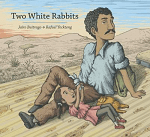
This story is from the perspective of a child who uses counting as a coping mechanism to distract herself from the difficult experiences in her journey to a new country. Though never mentioned in the book, both she and her dad are most likely Guatemalan refugees as Guatemalan worry dolls are shown at the beginning of the book, and illustrations of soldiers are sprinkled throughout the book. She also travels via train, most likely alluding to the infamously dangerous train dubbed as The Beast that runs from Guatemala all the way to the United States.
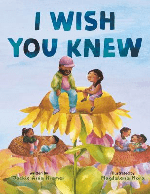
In this story, we follow Estrella whose father has been recently deported to their country of origin. She wishes people around her knew how her life has been affected by his absence. Her teacher notices she is withdrawn and distraught so she creates a safe space to talk about the things Estrella and her other students wish they knew. This gives Estrella the courage to share not only how much she misses her dad but also about the things they did together that brought her joy.
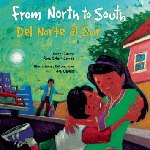
This story parallels Estrella’s story as Jose’s mom is also unexpectedly deported back to Mexico. Jose’s family lives close to The Tijuana US-Mexico border so Jose and his dad travel through the border to see his mom. Mama doesn’t know when she will come back to the United States. Jose and his dad must return to their home in the US without Mama. This is a book that tells the stories of countless children in between two borders.
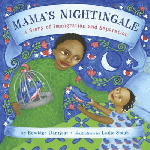
Saya’s mom is sent to a detention center for being undocumented. It’s been a long time since her mom’s been home and the only thing she finds comfort in is her mother’s greeting on the answering machine. After Saya accidentally deletes the answering machine greeting, Mama sends bedtime stories inspired by Haitian folklore on a cassette tape. Saya decides she will write a story of her own, one that could potentially help get her mother back home.
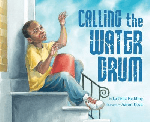
Henri’s uncle invites him and his parents to leave Haiti and come to New York City to live with him. Hoping for a better life, Henri and his parents leave on an old rickety boat. The boat overturns in the middle of a storm and Henri’s parents float further away as he calls to them. When he finally makes it to his uncle’s home in New York, he becomes withdrawn, unable to speak. One day he takes a bucket and uses it as a drum. It calls to him so he starts using it to cope and express his emotions.
This book is written by Areli Morales, a DACA ( Deferred Action for Childhood Arrivals) recipient who shares her own story as an undocumented immigrant child. In this moving picture book, Areli has to leave her home and Abuelita, to join her parents and her older brother Alex in New York. After her classmates bully her for not knowing English she learns about the term “Illegal”. Areli struggles with this imposed identity and the heavy consequences that could arise should anyone find out about her legal status. In the end, we see Areli give herself permission to dream and to exist just as she is.
The conversations you have with your child are creating a (1) rich vocabulary, (2) creative thinking, (3) conversation skills (e.g., taking turns, listening), (4) self-awareness and expression, and an attending mindset (e.g., making eye contact, body language, reacting by smiling, etc.).
Building a storytelling, reading, and singing routine is a quick way to boost your child’s early literacy skills. Parents can also engage their children by discussing what items to put in their cart at the grocery store. For example, you could discuss what the household is making for dinner, the array of colors you see in the food packages, and the texture of fruits and vegetables. Use descriptive words such as “smooth, shiny” or “fuzzy, soft”.
Reading a wordless book can give you and your child a chance to make up your own story.

 Featuring great books and exploring topics important to families, this page will make learning together interesting and fun.